Mobility One Selected for the “2026 Public-Private Open Innovation – Climate Tech Challenge”
Mobility One and K-water Jangheung Branch to Demonstrate an AI- and Autonomous Drone-Based Incident Monitoring and Rapid Response System for Local Water Supply Operations
Mobility One Inc. announced that it has been selected as a participating startup in the “2026 Public-Private Open Innovation – Climate Tech Challenge.”
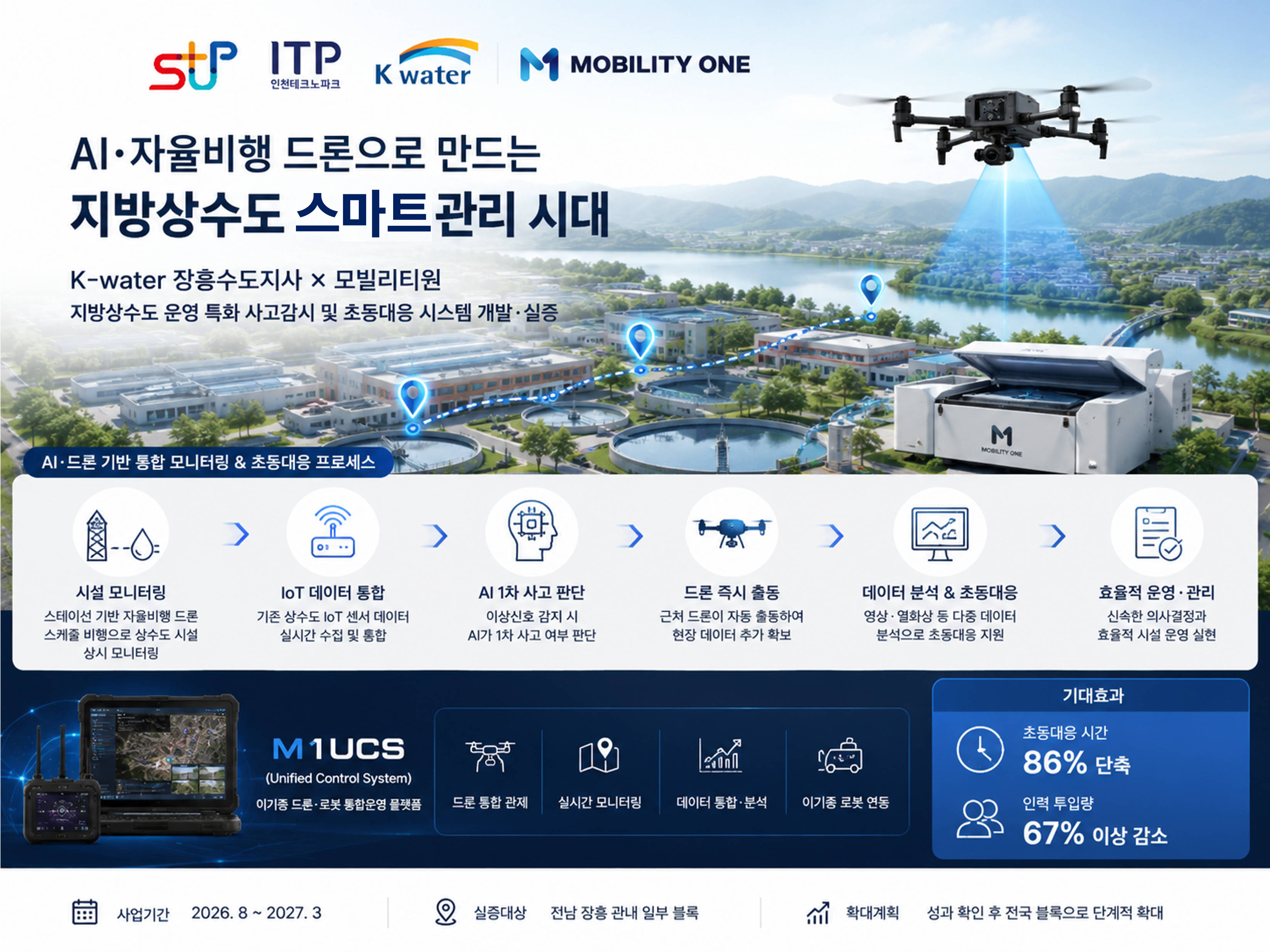
Under the program, Mobility One will work with K-water’s Jangheung Branch from August 2026 through March 2027 to develop and demonstrate an AI- and autonomous drone-based incident monitoring and rapid response system specifically designed for local water supply operations.
The project aims to establish a new operational model for more efficient management of expanding water supply infrastructure, while addressing structural challenges faced by regional communities, including population decline and shortages of field personnel.
Growing Water Infrastructure, Shrinking Workforce
Many regional areas in Korea are experiencing rapid population decline, while the length of water pipelines and the number of related facilities continue to increase. As a result, the cost and workload associated with maintaining water infrastructure are steadily growing.
At the same time, shortages of field personnel make it increasingly difficult to conduct regular preventive inspections across widely distributed facilities or to rapidly verify and respond to abnormal situations.
To address these challenges, Mobility One and K-water’s Jangheung Branch will demonstrate a continuous water infrastructure monitoring system that combines dock-based autonomous drones, existing IoT sensors, and AI-powered analytics.
Under normal operating conditions, autonomous drones deployed at drone stations will conduct scheduled flights to continuously monitor key water facilities, including pumping stations, reservoirs, and inspection sites. The goal is to shift from a predominantly manpower-intensive, reactive maintenance model toward a preventive management system capable of identifying potential abnormalities at an early stage.
AI Detects an Anomaly, Then the Nearest Drone Responds
A key feature of the demonstration is that it goes beyond routine drone patrols by integrating existing water infrastructure IoT sensor data and autonomous drones into a single incident response framework.
When IoT sensors installed at water facilities detect an abnormal signal, AI will first analyze the sensor data to make an initial assessment of whether an incident may have occurred and determine the situation.
If additional on-site verification is required, the autonomous drone located closest to the suspected incident site will be automatically dispatched.
The drone will then collect additional real-time data, including still images, high-resolution optical video, and thermal imagery. By analyzing this information, operators will be able to assess the incident and on-site conditions more quickly.
This approach is expected to significantly reduce initial response times for incidents such as leaks or facility abnormalities, as operators can obtain visual information and assess the situation even before field personnel arrive at the site.
M1UCS Integrates the Entire Process, Targeting an 86% Reduction in Initial Response Time
The entire workflow will be integrated and managed through Mobility One’s proprietary M1UCS (Unified Control System), an integrated operation platform for heterogeneous drones and robots.
M1UCS supports autonomous drone mission planning and flight operations, as well as real-time monitoring of drone locations and operational status. It also integrates IoT sensor information and visual data collected from the field, enabling operators to monitor and respond to the overall situation through a single platform.
Through the demonstration, Mobility One plans to verify whether the system can achieve an 86% reduction in initial response time and at least a 67% reduction in field personnel deployment compared with conventional water infrastructure management methods.
Rather than simply replacing human workers, the objective is to enable limited field personnel to efficiently manage a much larger geographic area and a greater number of facilities through automation and intelligent decision support.
“As populations decline in regional areas, the shortage of field personnel relative to the amount of infrastructure that must be maintained is expected to become increasingly serious,” a Mobility One representative said. “By connecting AI, IoT, and autonomous drones into a single operational framework through M1UCS, we aim to establish a new management model that enables continuous preventive monitoring of water infrastructure and rapid response when an incident occurs.”
The representative added, “Through this demonstration, we plan to validate both the quantitative benefits and real-world applicability of the system, and ultimately expand the technology beyond local water supply management to unmanned and automated operations across a wide range of infrastructure sectors.”
Pilot Demonstration in Jangheung, with Potential for Broader Deployment
The initial demonstration will be conducted across selected water supply blocks in Jangheung, Jeollanam-do.
Mobility One and K-water plan to evaluate the system’s technical reliability, operational efficiency, and improvements in incident response. Based on the results, they will also consider gradually expanding the system to additional water supply blocks.
By combining AI, IoT, autonomous drones, and an integrated unmanned systems platform, the project is expected to demonstrate a new model for smart water infrastructure management—one designed to address the practical challenges of population decline, workforce shortages, and the increasing burden of maintaining essential infrastructure.