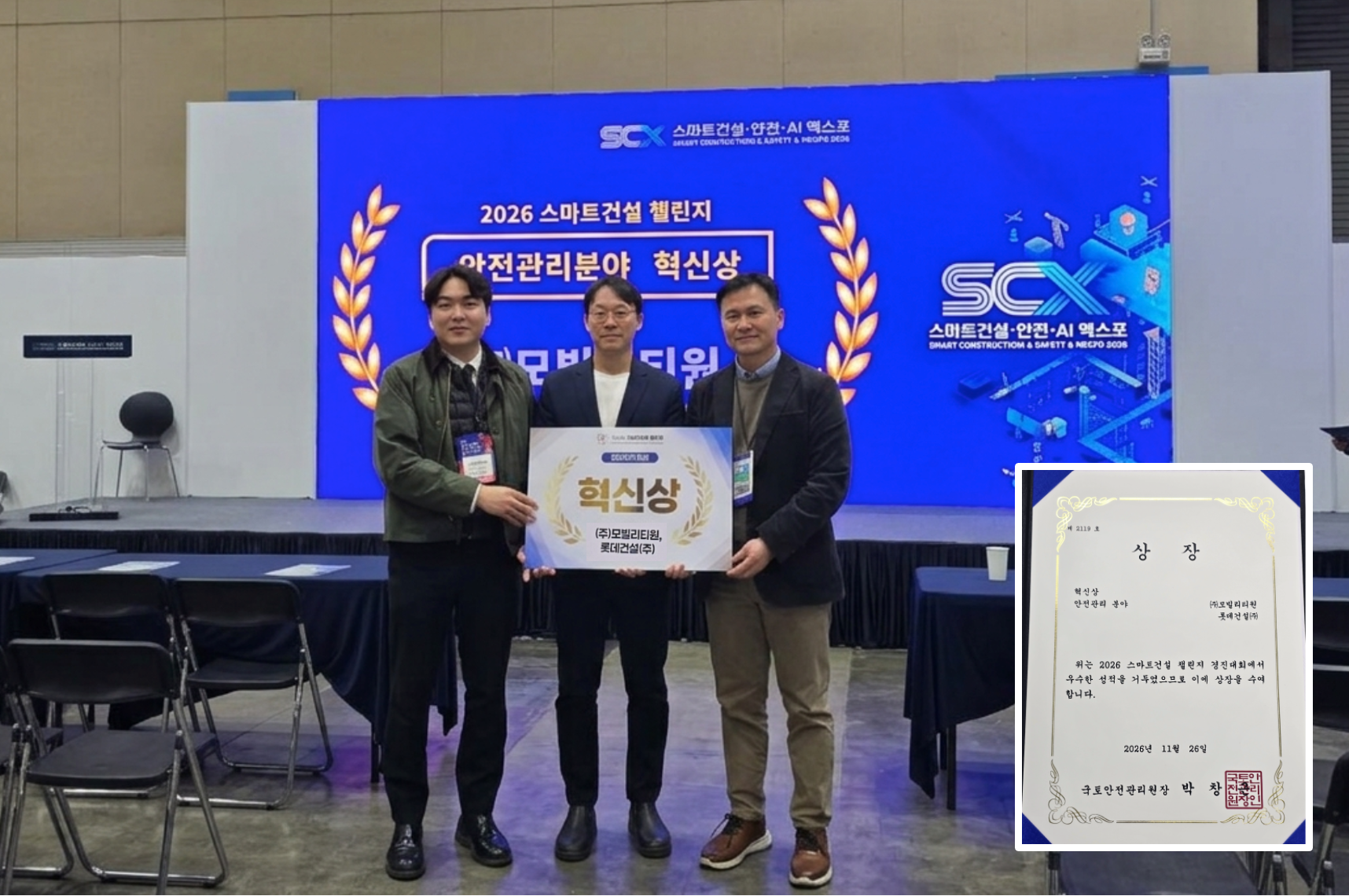
Mobility One Wins Safety Management Innovation Award at the 2026 Smart Construction Challenge
Indoor multi-drone autonomous inspection technology field-tested at a Lotte Engineering & Construction site.
Technology refined with on-site feedback, with a follow-up field trial planned for 2027.
Mobility One, a specialist in integrated drone and robot operations platforms, won the Innovation Award in the Safety Management category at the 2026 Smart Construction Challenge, held on November 26.
The Smart Construction Challenge is a technology competition hosted by Korea’s Ministry of Land, Infrastructure and Transport and jointly organized by the Korea Institute of Civil Engineering and Building Technology, Korea Land and Housing Corporation, Korea Expressway Corporation, Korea National Railway, and Korea Authority of Land & Infrastructure Safety.
The competition was established to identify promising smart construction technologies, promote their adoption and commercialization, and improve safety awareness and productivity across the construction industry. This year’s competition focused on whether technologies could be developed and deployed to solve real problems at construction sites and deliver tangible benefits to the public.
Mobility One presented an approach to construction-site safety management and facility inspection that combines its proprietary M1UCS (Mobility One Unified Control System), a platform for operating different types of drones and robots, with indoor autonomous flight technology.
M1UCS allows operators to manage multiple drones and robots from different manufacturers and of different models through a single platform. It supports real-time vehicle status monitoring, mission planning and execution, flight path management, and monitoring of video and sensor data.
The M1UCS Indoor/SLAM version uses LiDAR and simultaneous localization and mapping (SLAM) to help drones determine their position and carry out autonomous flight missions in indoor, underground, and confined spaces where GPS signals are unavailable. By using drones to inspect areas that are difficult or hazardous for people to access, the technology aims to reduce workers’ exposure to risk and make it easier to collect information about facility conditions and the surrounding site.
Lotte Engineering & Construction (Lotte E&C) played a key role in the achievement. It provided a site where Mobility One could test the technology under real construction conditions and offered detailed feedback on the functions and improvements needed for field deployment.
Based on that feedback, Mobility One improved indoor flight stability, inspection route planning, video and sensor data collection, and ease of use on site. The company said the award was particularly meaningful because the project went beyond a technology demonstration and incorporated actual construction-site requirements into the product.
The layout of construction sites, the location of obstacles, and working conditions change as work progresses. Dust, low light, complex structures, and the lack of GPS signals can also make conventional drones difficult to operate reliably. Deploying autonomous indoor flight technology therefore requires testing not only flight performance but also collision avoidance, positioning, communications reliability, data management, and ease of use.
Through its field trial with Lotte E&C, Mobility One identified these practical challenges and is developing M1UCS into a platform tailored to construction safety and facility inspection. The company expects that managing drone imagery and spatial data in one place, and using that information to repeat inspections and track changes over time, will help make safety management more efficient and objective.
“This Innovation Award reflects not only the capabilities of M1UCS but also the work we did with Lotte E&C to test its practical value at an actual construction site and refine it through ongoing feedback,” said Hyunwook Ryu, CEO of Mobility One. “What matters most in smart construction is whether the technology can be used safely and easily on site, not just what it can do in a lab.”
“Working with Lotte E&C helped us understand exactly what construction teams need and which problems still have to be solved,” Ryu added. “In 2027, we will build on what we learned in the field and carry out a more advanced follow-up trial.”
In the next phase, the two companies plan to improve the reliability of autonomous indoor flight and expand inspection coverage. They also plan to refine how multiple drones share inspection tasks, how AI detects anomalies, and how inspection data is managed and reported automatically. Based on the trial results, they will consider developing a standard operating model that can be applied across different construction sites.
Building on the award, Mobility One plans to strengthen its technical collaboration with Lotte E&C and expand its use of M1UCS for construction-site safety management and facility inspection.